Venice in a Minor Key
Notes from a Biennale held together by care
Written by Lawrence Murray, Saturday 9 May 2026
There is a particular sound to Venice during preview week: the slap of water against the stone of a vaporetto stop, the wheels of a press tote dragged over a bridge at seven in the morning, the clipped Italian of dock attendants directing the annual flotilla of curators, dealers, journalists and assistants who arrive before the city has properly woken up. I was there on a personal invitation, attending the preview on behalf of Guilloche Group.
This year the soundtrack carried something underneath it, a persistent unease that had nothing to do with the usual Biennale fatigue. The 61st International Art Exhibition opened amid turmoil. The entire international jury, handpicked by the late curator before her death, resigned on 30 April after announcing it would not consider for the Golden Lions any country whose leaders face International Criminal Court charges, a position widely read as aimed at Russia and Israel. On Friday 8 May, the eve of the public opening, around two thousand people marched in the first workers' strike in the Biennale's history, organised by the Art Not Genocide Alliance against Israel's and Russia's participation, and roughly twenty national pavilions, among them Austria, Egypt and Japan, closed in solidarity. And it opened, most significantly of all, in the shadow of Koyo Kouoh, who had shaped this exhibition before her sudden death on 10 May 2025 and would not be there to see it.
What is striking is that In Minor Keys has not been drowned out by the noise.
Kouoh asked, in the curatorial text she sent to the Biennale's president weeks before she died, that the show shift to a slower gear and tune in to the frequencies of the minor keys. Her collaborators, the advisors and editors she had appointed, have executed her vision with remarkable fidelity, and the result is an edition that, despite every reason it had to escalate, has chosen to whisper.
You feel it almost immediately in the central exhibition. There are 110 invited participants and very little of the techno-anxiety or didactic spectacle one might have expected from a Biennale opening in 2026. Maria Magdalena Campos-Pons's tribute at the Giardini's entrance, huge vertical panels of delicate magnolia and watercolour with Kouoh and Toni Morrison standing together, sets the emotional key. Theo Eshetu's olive tree on a slow rotating pedestal, chimes softly tinkling, sets the pace. Even Nick Cave, an artist often associated with maximalism, has filled the Arsenale with a multi-stage processional work shaped by cycles of grief and remembrance, moving between bronze figures and needlepoint self-portraits in a space that asks you to slow down before it asks you to think.
Within this register, Philip Aguirre y Otegui's contribution feels both at home and quietly singular. The Antwerp-based artist carries in his biography the kind of material his work has spent decades refusing to dramatise: a mother's family persecuted in wartime Europe, a father who fled the Spanish Civil War. Gaalgui Shelter (2026), his monumental installation at the Arsenale, draws its form from the painted wooden hulls of the Senegalese fishing boats that have carried so many migrants on clandestine crossings toward the Canary Islands. He has rendered the gaalgui as architecture, a hiding place, a lookout, a lighthouse, washed in the same sky-blue pigment as the originals. The project traces back to a larger gaalgui sculpture he first developed in 2008 with Kouoh's support, which lends this encounter an additional, quietly mournful resonance. The work doesn't shout about migration; it builds a structure inside which you think about it. That is his characteristic mode, and it earns the slowness Kouoh asked for. Worth disclosing: an upcoming Guilloche Group project will include a work by Aguirre y Otegui, which gave this encounter an extra layer of meaning, though the work would have held regardless.
The pavilions tell their own version of this story, often with more friction. Florentina Holzinger's Seaworld Venice, in the Austrian pavilion, has been the week's most discussed and most viscerally demanding work. Holzinger has converted the pavilion into a sealed ecological circuit: visitors urinate into two on-site toilets; the liquid is filtered and pumped into a large aquarium tank where performers float for hours at a time, breathing through scuba equipment. A side room churns with brown wastewater. To participate is to enter the system literally, to give something of your body to the work in order to see it.
The first time I stood in the queue I read it as provocation. The second time, after using the toilet myself and watching a performer drift past the glass, it read differently. The discomfort matters less than the intimacy. You become a small contributor to someone else's slow breathing.
Walking from Austria into the Egyptian pavilion next door, Armen Agop's Silence Pavilion: Between the Tangible and the Intangible was one of the strangest tonal shifts of the week. Agop has dimmed the space and suspended a sequence of meditative sculptures within it. There are no toilets, no instructions, no participation in the activist sense. There is only the request, almost devotional, that you stand still. Both pavilions ask the visitor to reflect; Holzinger arrives at contemplation through bodily implication, Agop through stillness, scent and the deliberate withdrawal of sound. As a pairing, which the geography of the Giardini makes almost unavoidable, they are the year's most accurate gloss on what minor keys actually means in practice: not quietude as decoration, but as method.
The motherhood thread running through this Biennale is not subtle once you start to see it. Ei Arakawa-Nash's Grass Babies, Moon Babies at the Japanese pavilion gives visitors a weighted, reflective-sunglass-wearing baby doll to carry through the space and surrounding garden. Each doll has an assigned birthday; inside its diaper, a QR code links to a poem. Arakawa-Nash, who became a parent to twins through surrogacy in 2024, has made the work in part out of their own queerness and the friction it produces against Japan's conservative political backdrop.
What seemed, on paper, like a gimmick became in practice the warmest room at the Biennale. People hold these dolls awkwardly at first and then differently, carefully, self-consciously, occasionally laughing. The reflective sunglasses turn the work back on you. It is the exhibition's clearest argument that care is a form of attention and attention is a form of politics.
The argument continues, in a very different register, at Salone Verde, where the singer-songwriter Jewel has staged Matriclysm: An Archaeology of Connections Lost in association with Crystal Bridges Museum. Across paintings, tapestries, sculpture, sound and live-streamed celestial and oceanic data, Jewel reaches for what she calls feminine systems of knowledge: the mythologies and practices eroded by extraction and acceleration. It is unfashionable in certain institutional circles to take celebrity art seriously, and Matriclysm does not ask you to resolve that discomfort in advance. It accumulates through abundance and proximity rather than argument.
The Pinchuk show is, for many people who saw it during preview week, the emotional centre of the Biennale outside the Giardini. Still Joy: From Ukraine into the World, curated by Björn Geldhof and Oleksandra Pogrebnyak at Palazzo Contarini Polignac, takes Hlib Stryzhko's testimonies as anchoring material for an exhibition that spreads outwards into works by Tacita Dean, Julian Charrière, Zhanna Kadyrova, Simone Post and others. Kadyrova's lightboxes photograph bombed-out interiors, each one containing a single rescued potted plant in the rubble; Post's candy chandeliers remake the palazzo as a child's hallucination of delight, their melt-ability the point. The show has received wide coverage across the international press, and rightly so. It is fragile in a way that most politically committed exhibitions cannot allow themselves to be, and it is the only show this week where I saw several people, separately, stop and quietly cry.
By the third day, the rhythm of the Biennale begins to do something strange to perception. You move from a palazzo smelling of beeswax and centuries to a PR breakfast in an air-conditioned anteroom, back out into the midday glare, and then down narrow calli that funnel heat in ways the tourist maps don't warn you about. Somewhere in this transit the art starts to flatten slightly. This is not a failure of curation. It is the condition of attending a Biennale, the specific fatigue of receiving too many things in too little time, the way the tenth pavilion of the day blurs into the ninth even when it is genuinely extraordinary.
It was in this state that Marina Abramović's Transforming Energy at the Gallerie dell'Accademia felt most welcome. Curated by Shai Baitel and marking the artist's 80th birthday, it is her first major exhibition there, and the first by a living woman in the institution's history, with her work installed directly among the permanent collection as well as the temporary galleries. It proposes a straightforward form of slowness: facilitators lead small groups through rooms of crystals, interactive stone objects, and a door that opens onto nothing in particular. Abramović has said she hopes visitors will spend at least three hours inside. The wait outside is part of the work. You arrive adjusted. She has spent a career building precisely this architecture of patience and now, finally, has a setting where it converses with Titian's unfinished Pietà across the gallery, her own Pietà (with Ulay) placed in dialogue with it 450 years on.
At the Scuola Grande di San Rocco, Jan Fabre has installed three new silicon-bronze sculptures along the building's central axis in dialogue with Tintoretto's monumental cycle, the first time a living artist has been invited to intervene in that space. The exhibition, The Quiet Source, is curated by Giacinto Di Pietrantonio and Katerina Koskina. I attended the preview through an invitation from Joanna De Vos, Fabre's wife, and the work carries her presence directly: The Artist as a Stray Dog in His Basket depicts the artist curled in a basket with a marmot, an affectionate reference to Joanna, lying across his back. To be in that room with Fabre's low, vulnerable bronzes and Tintoretto's sublime and terrifying biblical gloom is to understand what a serious act of scale judgment the former required. Fabre understands that the only respectful way to enter that room is small.
The AI question, widely anticipated as this Biennale's ideological battleground, has not materialised as one. At Palazzo Diedo, Mat Dryhurst and Holly Herndon's Strange Rules treats it as a research field among others. The Holy See pavilion uses it as one compositional voice alongside Brian Eno, FKA Twigs and Precious Okoyomon.
Nowhere is this quieter reframing more legible than at Palazzo Pisani Moretta, where the Dries Van Noten Foundation has staged its inaugural public exhibition. The Only True Protest Is Beauty, curated by Van Noten together with Geert Bruloot, brings fashion, jewellery, ceramics, photography, glass, sculpture and design into a single space in a way that dissolves disciplinary boundaries almost entirely. The effect is closer to a cabinet of curiosities than a conventional exhibition: historical ornament and contemporary craft in continuous dialogue, the rooms accumulating a kind of layered attention that resists easy categorisation.
What the exhibition is quietly arguing, even if it never raises its voice, is that beauty is not comfort. It is not retreat. It is a form of remaining attentive to the world at a moment when the world is producing images faster than anyone can look at them. The tension is not entirely new: the Industrial Revolution generated similar anxieties about mechanisation and the erosion of human craft, producing in response movements like Arts and Crafts and, later, Art Nouveau. In Belgium specifically, figures like Henry van de Velde insisted that modernity did not have to come at the expense of artistry, that everyday objects still deserved care, ornament and imagination. Joseph Arzoumanov, one of the show's younger participants, has built a hyper-decorated chessboard whose narrative is governed by AI logic, jewel-like Kings and Queens moving through a family story. It is calm, integrated, almost ornamental: AI here as a collaborator that has learned to behave. Within the fading grandeur of the palazzo, this feels exactly right, beauty not as escape, but as insistence that human perception still has something to say.
Among the structural shifts, the Qatar pavilion is impossible to ignore. Its presentation this year, untitled 2026 (a gathering of remarkable people), conceived by Rirkrit Tiravanija and co-curated by Tom Eccles and Ruba Katrib, takes the form of a maroon, majlis-inspired tent built on the site of Qatar's future permanent pavilion, designed by Lina Ghotmeh. That permanent structure, when it is built, will be the first new national pavilion added to the Giardini in three decades, the first since Korea in 1995. The tent is the prelude, not the building itself. In February I was at Art Basel Qatar's inaugural edition in Doha, watching a fair testing how Gulf institutions might inherit, and reshape, the Western art-world model. In Venice three months later, the trajectory is legible: from staging legitimacy to building institution, from the fair floor in Doha's M7 toward a permanent plot in the Giardini. In a landscape that has barely changed in decades, even the promise of a new pavilion carries weight you feel in your feet when you walk past.
Beyond the official venues, the city continues to overflow. Punta della Dogana holds Lorna Simpson and Paulo Nazareth simultaneously. Jenny Saville's first major Venice exhibition, supported by Gagosian, shows at Ca' Pesaro in dialogue with the Venetian masters. The Peggy Guggenheim Collection remains, as ever, the stop that swallows an entire afternoon and gives it back as an evening. Between palazzo and pavilion, vaporetto and queue, the particular light that arrives over the lagoon around six o'clock, that specific, unrepeatable Venetian pink, you accumulate the half-thought, half-fatigue that is this city's gift and its tax.
The Biennale is overcrowded, contradictory, institutionally stressed. It is hosting states whose participation many of its own artists protested, and it opened without its own jury and without its Golden Lions. Its founding curator is gone. And it is still, and this remains true despite all of it, the only place in the world where this particular conversation occurs at this scale, in this density, in this city. Kouoh's quietness was not a retreat from politics. It was a method for surviving it. You just have to be willing to stop talking long enough to hear them.
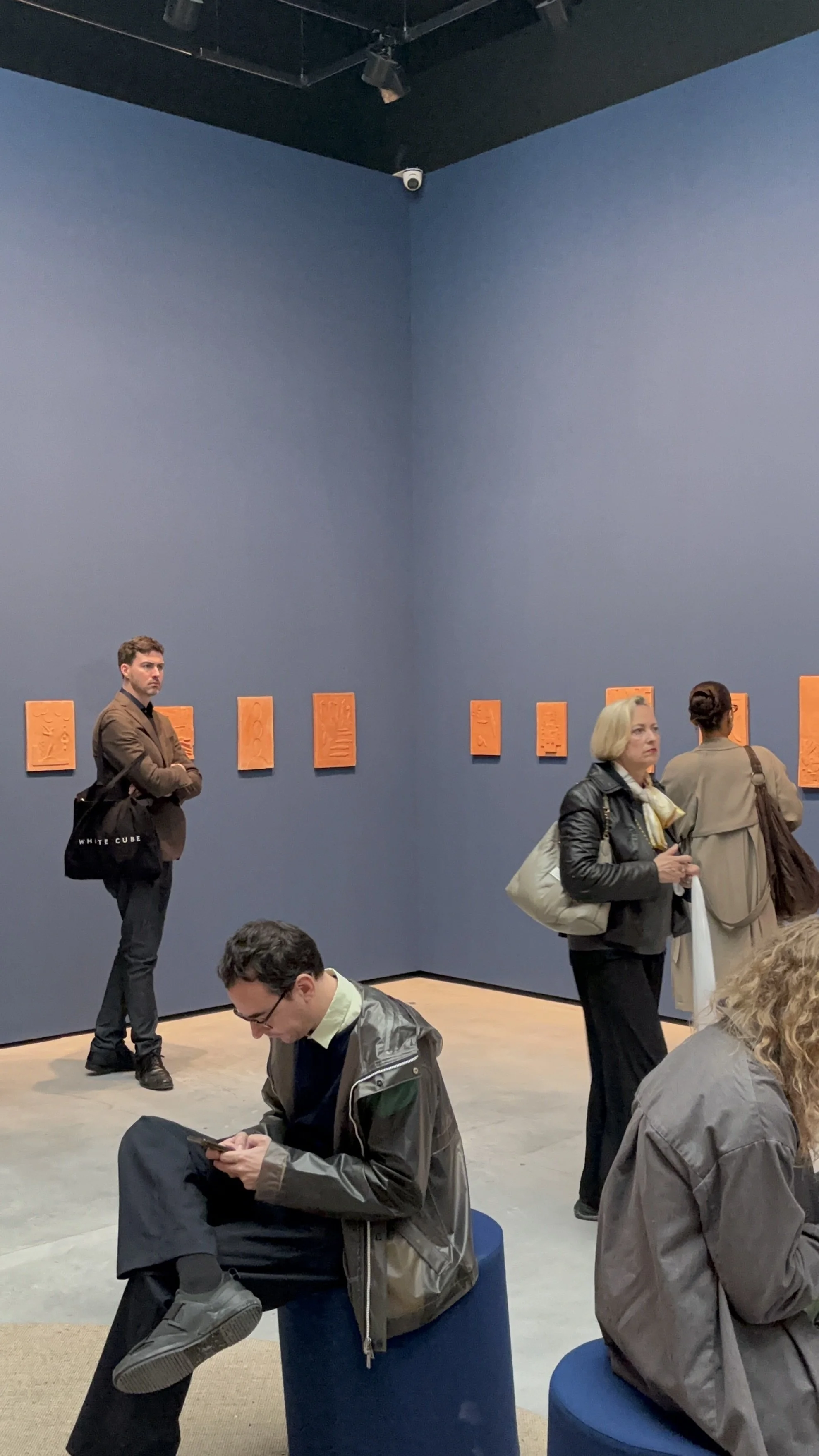
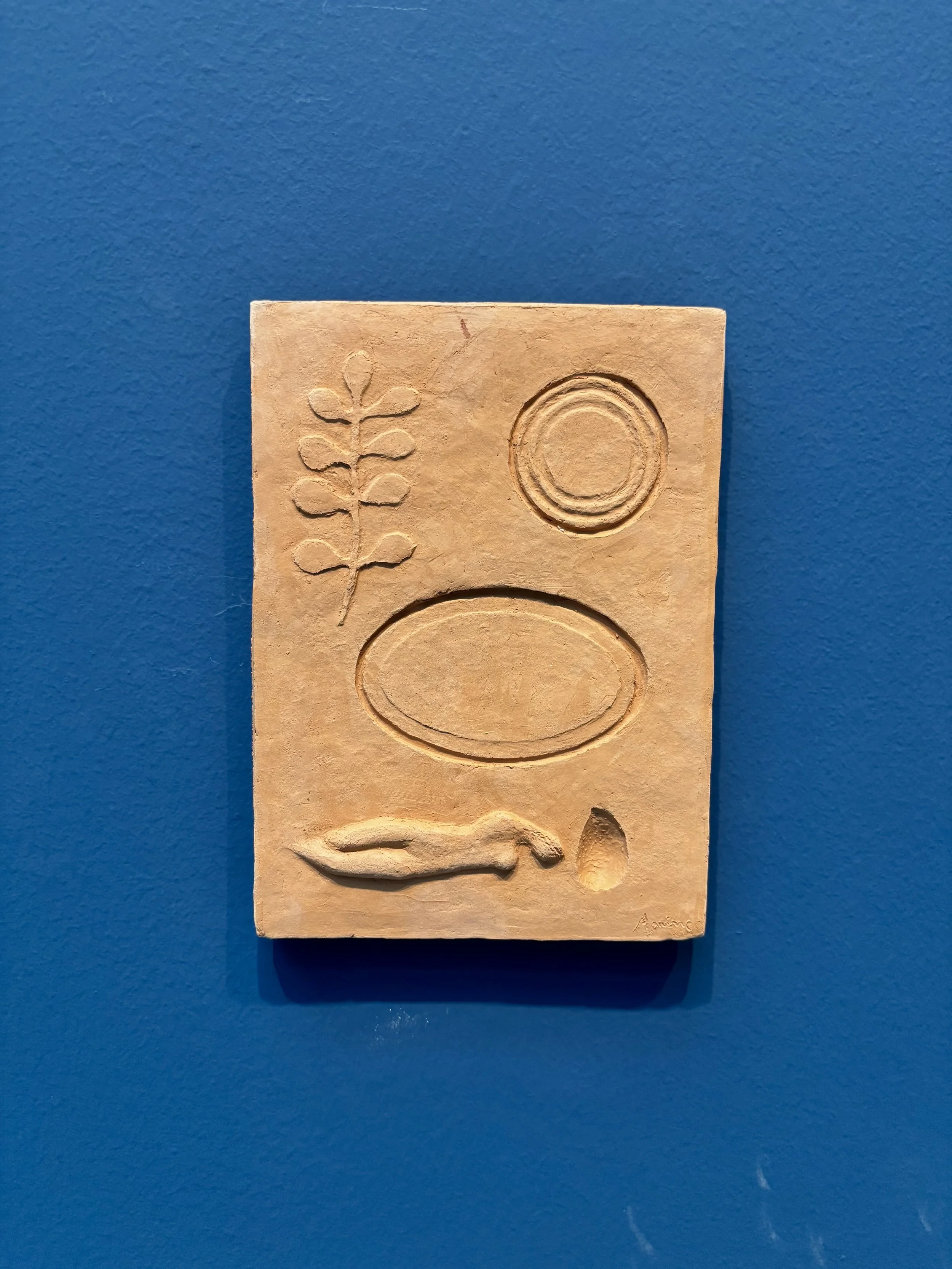
Philip Aguirre Y Oetgui’s sculpture “courtyard” will be presented by Guilloche Group this summer