Guilloche Group founder, Lawrence Murray, was present at the preview of Philip Aguirre y Otegui’s major new exhibition at the KMSKA on Friday evening. Having followed the exhibition closely over the past months and developed a personal connection with Aguirre and his work, Lawrence reflects on the exhibition, the artist’s ideas around beauty, migration and shelter, and the significance of seeing his work brought together on this scale.
3 October 2026 · Lawrence Murray
Philip Aguirre y Otegui at KMSKA: Beauty as Shelter
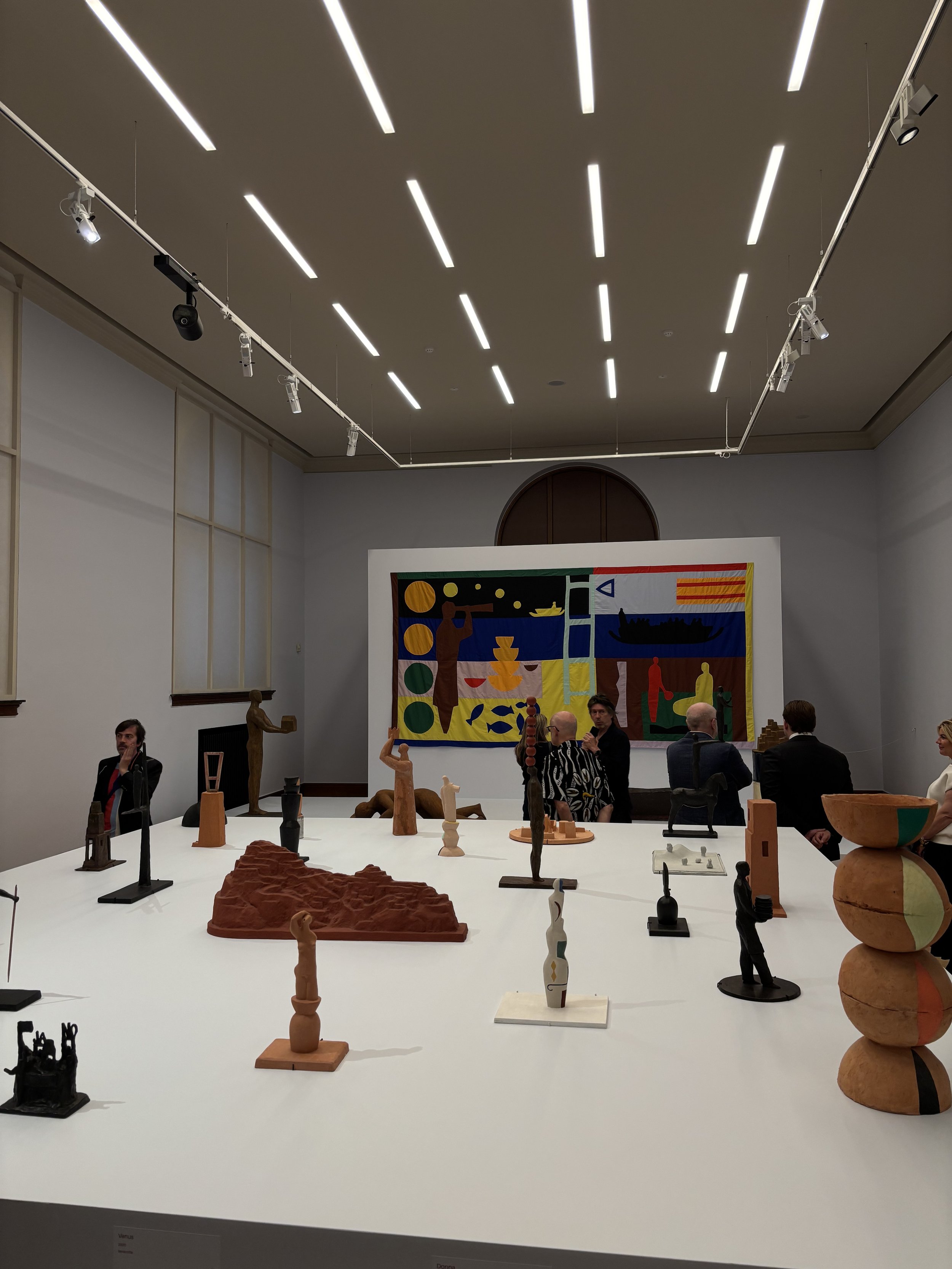
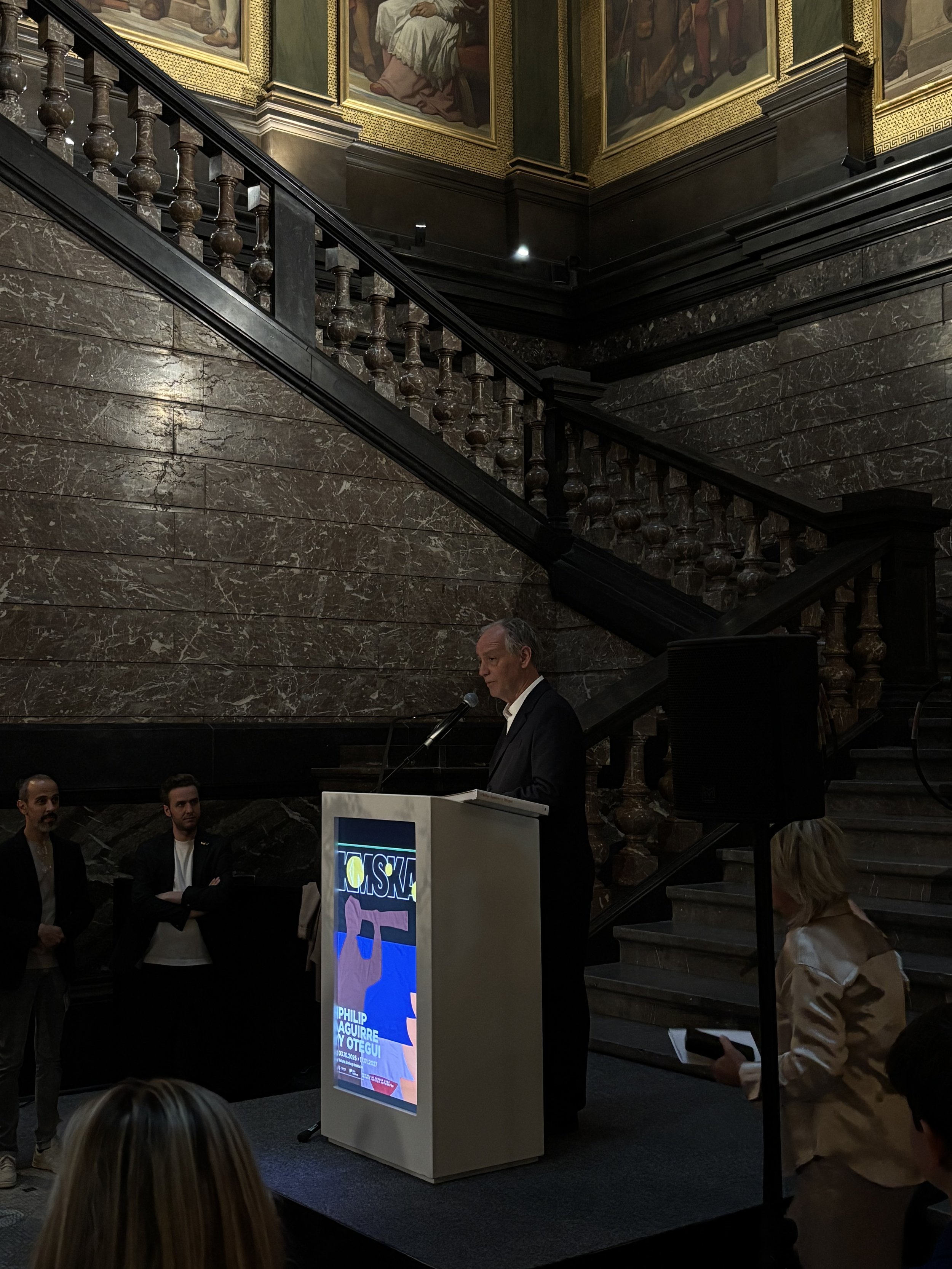
On Friday evening, the KMSKA in Antwerp unveiled its exhibition of Philip Aguirre y Otegui. With more than a hundred sculptures, drawings and prints spanning over forty years, it is the largest survey of his work to date, and, in my view, one of the most important exhibitions in Belgium right now. The exhibition officially opened to the public on Saturday and comes in a significant year for Aguirre, whose work is also being presented at the Venice Biennale.
I have followed this exhibition for months. Seeing it fully realised, after watching these works take shape and move between the studio and the museum, was a very special moment.
My first encounter with Aguirre’s art was not in a museum. It was at Bernaerts Auctioneers, where I assisted with the Graanmarkt 13 estate sale during my internship. The collection included several of his prints. They led me to his broader practice, and I was immediately captivated.
Not long after, I acquired one of his sculptures, Courtyard, for the small but growing collection at Guilloche. I also took the leap of emailing Philip directly. That first message grew into a series of conversations and meetings, first in his Antwerp studio and later in Venice. Over the past few months, I have had the privilege of watching this exhibition come together.
The exhibition brings together Aguirre’s work from the 1980s to today, placing monumental sculptures alongside smaller works, drawings and prints. Its themes come from close to home. Aguirre’s father fled the Basque Country during the Spanish Civil War and built a new life in Belgium. Migration, human dignity and vulnerability have remained central to Aguirre’s work ever since.
Inside the KMSKA, those ideas take on a particular form. Aguirre turns the galleries into an imagined refuge, while the sense of safety inside the museum is constantly set against the uncertainty of the world outside. Curator Annelien De Troij builds the exhibition around a difficult question: how do we reconcile our desire for a private paradise with a world that has gone off the rails?
The museum describes this as a “contrary game” with the idea of the museum as an oasis. That tension runs through the entire exhibition.
A conversation we had in Venice has stayed with me. That morning, I had visited Dries Van Noten’s The Only True Protest Is Beauty at his foundation in Palazzo Pisani Moretta. Later that day, Philip and I spoke about the importance of beauty in art.
Beauty is everywhere in Aguirre’s work, even when he is dealing with migration, dignity or the need for shelter. It does not make these subjects easier or less serious. If anything, it gives us a way of staying with them.
The KMSKA puts it beautifully: for Aguirre, the search for beauty is a need as fundamental as water and bread. His work carries a belief that beauty can contribute to a more equal society.
At the same time, Philip is very sober about what art can actually achieve. Art will not save the world, he says. But it can move one person, make them think, or simply make them glad. Looking at these works, I found myself returning to that idea. Perhaps art does not need to solve anything in order to matter.
Aguirre takes familiar classical motifs and changes what they carry. A caryatid supports a wounded body instead of a building. A triumphal arch becomes fragile. In Matrasdrager, a monumental figure shoulders the very ordinary weight of a mattress.
The materials are direct: plaster, bronze, terracotta, wood and paper. The surfaces retain the marks of their making, and the physical weight of the sculptures remains present. There is very little distance between the viewer and the objects.
Aguirre’s work has been discussed alongside Goya, Rodin and Ossip Zadkine, artists who also searched for human responses to turbulent times. The KMSKA will open Ossip Zadkine and Belgium on 31 October, making that connection particularly interesting within the museum.
There is also something special about seeing a living artist given an exhibition of this scale. The KMSKA is not presenting Aguirre through another artist’s work or as part of a historical survey. The space belongs to him. Every room and every wall is filled with his work.
His sculptures still enter into conversation with the traditions that came before them, but the conversation happens on his own terms.
The recognition extends beyond Antwerp. Aguirre is currently featured in In Minor Keys, the 61st International Art Exhibition of the Venice Biennale. Philip has spoken to me about his close connection with the late Koyo Kouoh, who conceived the exhibition and supported the presentation of his work in Venice.
A major survey in Antwerp and a presentation in Venice place Aguirre’s work in two very different contexts this year.
His sculpture also belongs in public space, and the exhibition makes that clear. Théâtre Source (2013) is both a functioning water source and a meeting place designed for a neighbourhood in Douala, Cameroon. Matrasdrager gives a monumental figure the very ordinary weight of a mattress.
The KMSKA has also acquired Petit Monument on the occasion of the exhibition, and the work will take up a permanent position outside the museum. I find that particularly meaningful. The exhibition itself is temporary, but one of Aguirre’s works will remain part of the museum and its surroundings long after the show closes.
For me, though, what has stayed with me most from these months is Philip himself.
At the opening on Friday, I spoke with many people about him and his work. Again and again, the same thing came through: he touches people.
He is at a remarkable point in his career, yet remains remarkably humble. He makes time for long conversations and takes a genuine interest in the people drawn to his work. I have experienced that myself, and it has stayed with me.
I have seen these works in the studio, raw and unfinished, moved around, discussed and reconsidered. I have encountered them in Venice and Antwerp, and talked about them with Philip long before they found their final place in the museum.
On Friday evening, I finally saw them all together.
Congratulations, Philip. It has been a privilege to watch it come together.
Philip Aguirre y Otegui is now open at the KMSKA in Antwerp and runs until 17 January 2027. Philip will give an artist talk at the museum on 8 October.
In Minor Keys, the 61st International Art Exhibition of the Venice Biennale, runs until 22 November 2026.